



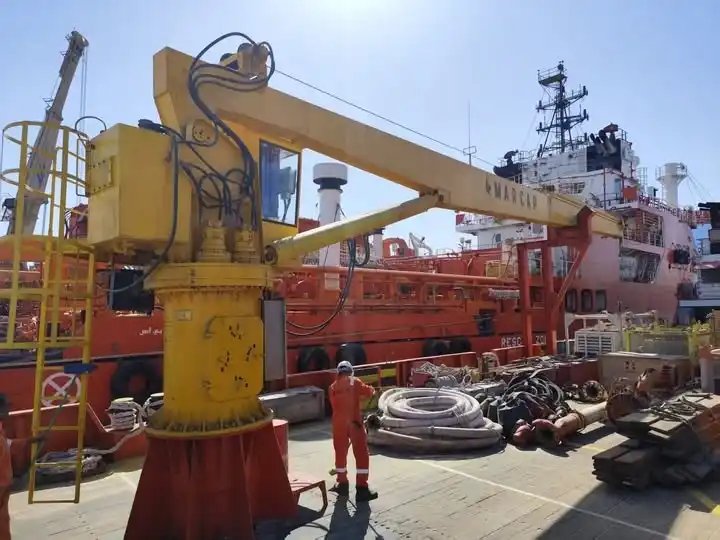
MARINE KNUCKLE BOOM CRANE ON A NORTH SEA PSV: AHC, COLD START, AND WHAT TO SPECIFY
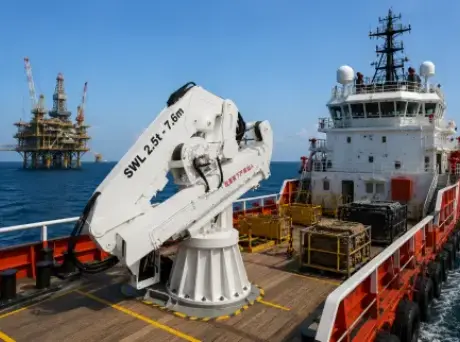
A lot of vessel operators buy a deck crane with a spec sheet that looks fine — then run into problems the first North Sea winter.
This article is based on a real project we delivered in 2023 for a Norwegian offshore shipping company. It covers what a marine knuckle boom crane installed on a PSV deck actually needs to handle North Sea conditions, where things tend to go wrong, and what questions are worth asking before you sign a purchase order.
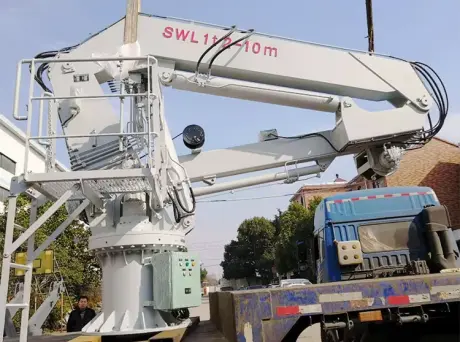
The Project: A PSV Refit with a Hard Deadline
The client operates a fleet of platform supply vessels serving North Sea oil and gas fields. In late 2022, one of their older supply vessels picked up a new long-term resupply contract — but only if a new deck crane could be fitted before the contract start date.
Their requirements were specific:
Fold to a minimal footprint when not in use, without blocking deck cargo movement
Operate reliably in North Sea winter conditions, including temperatures down to -20°C and heavy seas
Active heave compensation (AHC) — non-negotiable
That third requirement was the hard constraint. The new contract involved lifting precision equipment onto offshore platforms. Without AHC, the hook moves with the vessel as it pitches and rolls. Loads swing. Equipment gets damaged. The contract cannot be fulfilled.
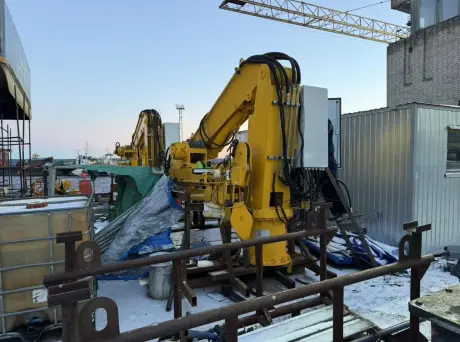
Why a Folding Knuckle Boom, Not a Stiff Boom or Telescopic
Deck space on a PSV is expensive. Pipes, drill consumables, and containers fill every available metre. A fixed stiff boom sits there with the arm extended when it's not working — blocking access, getting in the way of cargo handling.
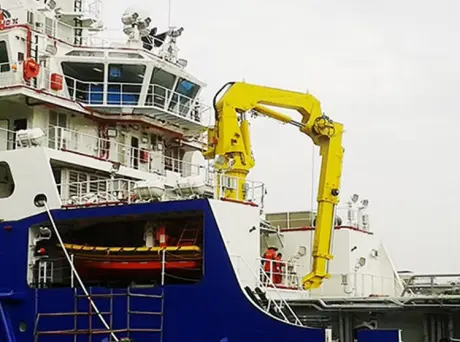
A well-designed marine knuckle boom crane folds back against its pedestal into a compact vertical form when parked. The deck space it frees up is significant. For a PSV that needs to maximise cargo on every run, that difference shows up directly in operating economics — fewer trips, lower fuel cost per tonne delivered.
This is why the folding knuckle boom has become the standard configuration for North Sea PSV deck cranes. Not because it's cheaper — it isn't — but because it lets the vessel earn more.
For a comparison of crane types and when a telescopic boom crane makes more sense, see our marine crane selection guide.
Three Real Challenges in North Sea Conditions
Challenge 1: Cold Start and Hydraulic Stability
At -20°C, standard hydraulic oil thickens. Pressure builds slowly, valve response degrades, and in serious cases the system won't start at all.
For this crane, our engineers specified low-viscosity synthetic hydraulic fluid rated for sub-zero operation, and fitted thermostatically controlled heaters on the hydraulic tank and main valve blocks. Before start-up, the heaters bring the oil temperature up to normal operating range. Cold-start failure is eliminated at the design stage, not patched after the fact.
This isn't complicated engineering. But it has to be written into the specification before the crane is built — not discovered on the first winter deployment.
Challenge 2: Calibrating the AHC System
The principle behind active heave compensation is straightforward: sensors monitor vessel motion in real time, and the control system drives the winch in the opposite direction to keep the hook stationary relative to the sea floor or target platform.
In practice, it's precision work.
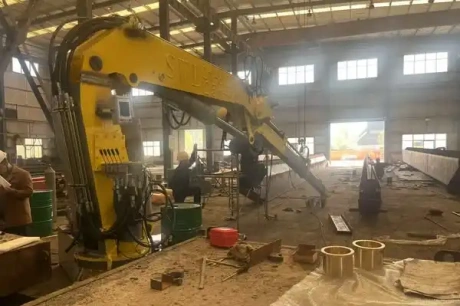
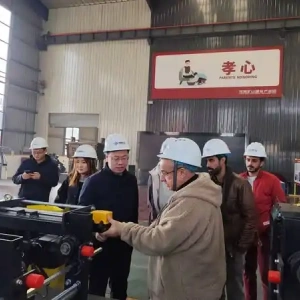
Our commissioning engineer spent three weeks at the Norwegian shipyard. During sea trials in the fjord, he ran the AHC system through repeated tests across different sea states and load configurations — comparing actual hook displacement against the theoretical compensation values, then adjusting the control algorithm's gain parameters after each run.
By the end of the third week, the system met the client's contractual compensation performance requirements. The client's own engineers were present throughout and signed off the results before accepting delivery.
Three weeks is not padding. It's what AHC calibration actually takes on a working vessel.
Challenge 3: Corrosion Protection That Holds
The North Sea combines high salinity, sustained wind, and near-constant humidity. A crane finished to standard C4 marine coating specifications will show rust within three to five years in that environment.
This crane's hydraulic lines are full stainless steel throughout. The structural coating was specified to C5-M offshore standard. Electrical enclosures are sealed to IP66. These choices add cost at the quotation stage. They cost considerably less than replacing corroded pipework three years into a 15-year crane service life.
Full Specifications
| Parameter | Specification |
|---|---|
| Safe working load | 10 tonnes |
| Maximum working radius | 18 metres |
| Drive system | Electro-hydraulic |
| Slewing | 360° continuous |
| Active heave compensation | Yes (AHC) |
| Operating temperature range | -20°C to +45°C |
| Hydraulic lines | Full stainless steel |
| Corrosion protection | C5-M offshore standard |
| Electrical enclosure rating | IP66 |
| Production completed | Early 2023 |
| Installation and commissioning | June 2023 |
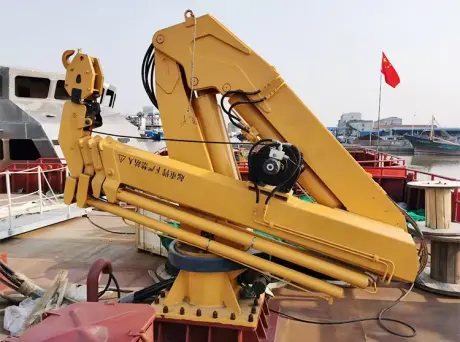
What Happened After Delivery
The crane entered service in mid-2023. Client feedback since then has focused on two things.
First, AHC performance during the winter lifting campaigns. In conditions with air temperatures below -10°C and swells above two metres, the hook held steady. The critical equipment lifts the contract required were completed without incident. For the client, those jobs were contract-defining moments — the crane didn't fail them.
Second, the deck space freed by the folded boom. The operations team found they could consistently load more cargo per run. Across a long-term supply contract, that reduces trip frequency and cuts fuel cost per tonne delivered.
In 2024, the same shipping company contacted us again to commission a second crane — same configuration, slightly higher capacity — for another vessel in their fleet. Their in-house engineers also recommended the setup to technical directors at peer companies in the North Sea supply sector.
More project details are available on our case studies page.
Questions Worth Asking Any Crane Supplier
Most procurement enquiries focus on rated capacity and working radius. For demanding environments like the North Sea, a few additional questions are worth asking directly:
What is the AHC compensation efficiency, and under what sea state was it tested?
The difference between 90% and 98% compensation efficiency is significant in real operations. Ask for test data from actual sea trials, not just theoretical figures.
What is the cold-start temperature rating, and what heating provisions are included?
A supplier who states "-20°C capable" without specifying hydraulic fluid grade and heating arrangements is giving you a number without the engineering behind it.
What corrosion protection standard are the structural coating and hydraulic lines built to?
C4 and C5-M cost similar amounts at procurement. In an offshore environment, the service life difference is three to five years.
Will your engineers come to the yard to calibrate the AHC system?
AHC is not a fit-and-forget system. It requires calibration under real sea conditions. If a supplier doesn't include on-site commissioning as part of their scope, the question of whether the AHC will actually perform to spec is unanswered.
If you're specifying a knuckle boom crane with AHC for a PSV or offshore support vessel, send us the vessel type, operating area, and primary lift requirements. We'll confirm whether our range is a fit and provide the full load chart for your working radius.
FAQ
How long does AHC calibration take on a working vessel?
Typically two to four weeks of sea trials, depending on sea state availability and the range of load configurations that need to be tested. Build this into your project schedule — it depends on weather and vessel availability, neither of which can be compressed.
Knuckle boom or telescopic boom for North Sea PSV work?
Depends on the primary operation. For precision lifts onto platforms, lifts in confined deck areas, or work requiring the boom to route around deck obstacles, the knuckle boom is the better choice. For straight over-the-side lifts at long radius, a telescopic boom is structurally more efficient. Many PSVs carry both configurations.
What classification society certification is available?
DNV is the standard requirement for Norwegian-flagged vessels. We can configure certification to match the client's flag state — DNV, BV, ABS, LR, or others as required. Confirm the certification requirement before placing the order; it affects the manufacturing process, not just the documentation.
What is the typical lead time?
For a standard AHC knuckle boom crane configuration, production runs 14 to 18 weeks, plus shipping. Non-standard specifications or additional classification society survey requirements extend this. Confirm lead time before committing to a drydock schedule.
Discussing a Deck Crane for Your Vessel?
We've supplied marine knuckle boom cranes to PSVs, offshore support vessels, and repair yards across Norway, Southeast Asia, the Middle East, and West Africa. Each project starts the same way: vessel type, operating environment, and the primary lift requirement.
If you're at the specification stage — or just trying to figure out whether a folding boom or telescopic arm suits your operation better — send us the details. We'll confirm whether our range fits, provide the load chart for your working radius, and give you a realistic lead time based on your delivery window.
No pressure. If it's not the right fit, we'll tell you that too.
HENAN YUNTIAN CRANE CO., LTD.
Email:sales@sgycranes.com
Website: [https://yuntiancrane.com/]
Whatsapp:+86-17337353108


