



DECK CRANES ON PSVS AND SOVS: A PRACTICAL GUIDE FOR OFFSHORE WIND SUPPORT OPERATIONS
The Quiet Equipment Decision That Shapes How an Offshore Wind Support Vessel Actually Works
A Market That Has Grown Faster Than the Fleet
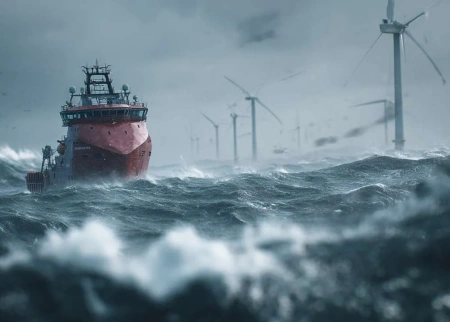
The offshore wind sector is expanding faster than most vessel operators anticipated five years ago. There are currently 29 SOVs in service globally — all in Europe — with a further 14 under construction and charter day rates running at around £30,000 per day. PSVs working offshore wind substation supply and construction support have become a structurally separate demand stream from traditional oil and gas platform support.
Why the Deck Crane Gets Overlooked — and Why That's a Mistake
The deck crane on these vessels is not a headline item in the way the DP system or motion-compensated gangway is. But it's the equipment that determines whether spare parts get transferred cleanly, whether technicians can work safely around the deck, and whether the vessel can operate in moderate swell without pulling the crane out of service.
How the Wrong Specification Shows Up in Operation
Getting the specification wrong is not a dramatic failure. It shows up slowly — as a crane that blocks the working deck when parked, hydraulics that struggle in winter, or a boom that can't reach the transfer point it was bought to handle.
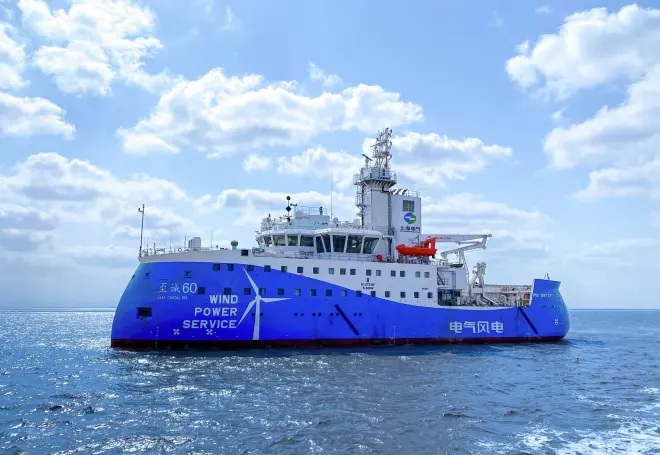
PSVs and SOVs Are Not the Same Vessel, and Their Crane Requirements Differ
What PSVs Do in an Offshore Wind Context
1.Platform supply vessels in offshore wind operations primarily support installation and commissioning phases — moving bulk materials, fuel, and equipment to offshore substations and cable-lay vessels. Their decks are wide, cargo throughput is high, and the crane is used for general stores handling more than precision placement work. Utilisation of large North Sea PSVs has been running above 85% through 2024 and into 2025, with day rates for modern DP2 vessels in the $22,000–$32,000/day range.
2.For PSVs, the crane specification is driven by cargo throughput and deck clearance. A crane that folds cleanly when not in use matters because the deck is the revenue-earning surface.
What SOVs Do — and Why the Crane Requirement Is Harder
1.Service operation vessels work differently. They stay on station at a wind farm for weeks at a time, acting as a floating base for maintenance technicians. Up to 100 technicians live aboard. The SOV's crane handles spare parts, tooling, replacement components, and equipment transfers to turbine access platforms — often in conditions where precision matters more than speed.
2.Construction SOVs (CSOVs) are a distinct sub-category, designed for commissioning phases rather than ongoing maintenance, with larger crane capacities and more personnel accommodation than standard SOVs. The crane specification on a CSOV is closer to a light construction vessel than a standard support vessel.
The Crane Type Decision
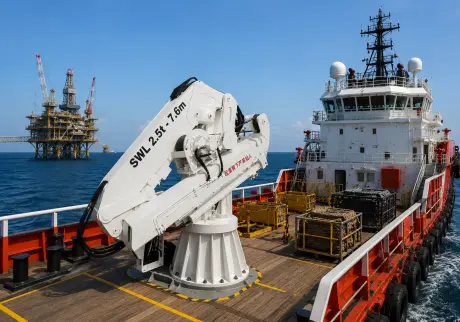
Marine Knuckle Boom Crane: The Standard Choice for SOVs
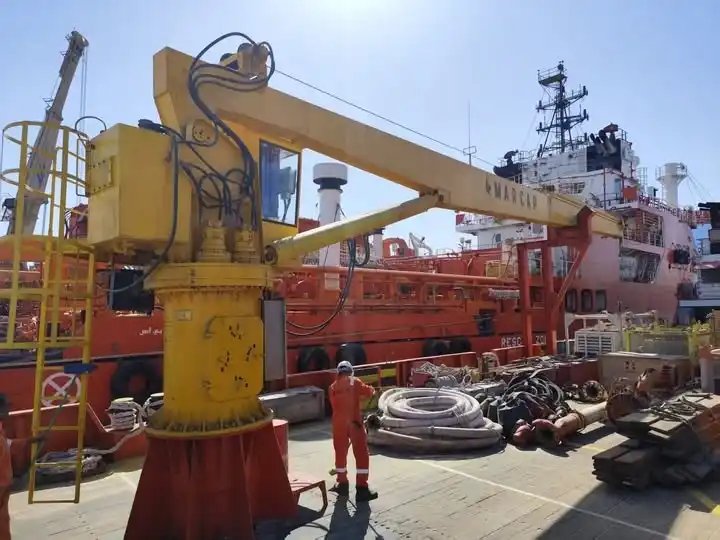
1.The knuckle boom crane — two articulated boom sections joined by a hydraulic joint — folds to a compact parked position against the pedestal. On an SOV deck that also carries gangway systems, rescue boats, and technician equipment, this matters. The deck clears when the crane is not in use. Crew and equipment can move freely.
2.The trade-off is maintenance complexity. More joints mean more hydraulic hoses, pins, and bushings to service. On an SOV that rotates through port inf
requently, maintenance access and spare parts availability need to be planned for. Operators who underestimate this find the crane out of service at inconvenient points in a long offshore deployment.
3.Capacity ranges for offshore-grade knuckle boom cranes run from 3 tonnes to 100 tonnes, with working radii up to 50 metres. For most routine SOV lifting work — spare parts, tooling, provisions, and equipment transfers to turbine platforms — units in the 5–30 tonne range cover the majority of operations.
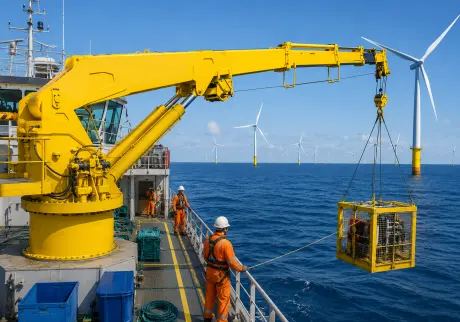
Marine Telescopic Boom Crane: Better for PSV Over-the-Side Work
1.The telescopic boom extends and retracts in a straight line, giving good reach without the joint complexity of a knuckle boom. It works well on PSVs where the primary requirement is over-the-side lifting at variable radii and the deck layout gives the boom room to stow without interfering with cargo areas.
2.The maintenance point to watch is the telescoping section seal. In sustained salt-spray exposure, the interface between sections is a location where corrosion and contamination accumulate. Operators who miss this find the extension mechanism stiff or seized.
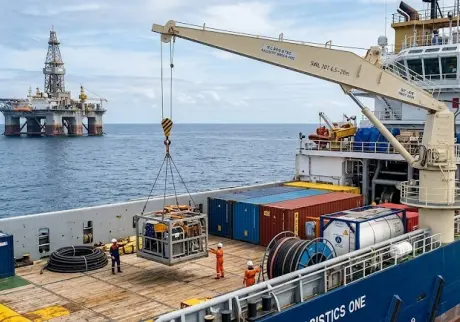
Marine Stiff Boom Crane: Simpler, But Only Where Deck Space Allows
The marine stiff boom crane is mechanically the simplest option and carries the lowest initial cost. It works for predictable, repetitive lifts on larger PSVs where the deck is wide enough that an extended boom doesn't block operations. On compact SOVs where deck space is genuinely constrained, the stiff boom's stowage footprint is its main liability.
Active Heave Compensation: The Specification Decision That Gets Misunderstood
What AHC Actually Does
Active heave compensation keeps the hook position stable relative to a fixed external point while the vessel moves with the swell. Sensors monitor vessel motion in real time; the control system drives the winch in the opposite direction to cancel the movement at the hook. The result is a hook that stays approximately stationary while the vessel pitches and rolls beneath it.
When AHC Is Worth the Cost
1.AHC is necessary when the lift involves placing a load onto a fixed target that doesn't move with the vessel — setting components onto a turbine access platform, or lowering equipment to a fixed structure. Without AHC, the hook swings with the vessel. In any meaningful sea state, the load becomes a pendulum. The risk is collision with the target structure, damage to the component, or injury to personnel guiding the lift.
2.For SOVs working in North Sea or northern Baltic conditions — where significant wave heights in winter routinely run at 2–3 metres — AHC is often written into vessel approval criteria by wind farm operators before the vessel enters service.
When AHC Is Not Necessary
1.For ship-to-ship supply, deck-to-deck stores handling, and lifts where the receiving point moves with the vessel, standard proportional hydraulic control is adequate. Specifying AHC for these operations adds cost and maintenance complexity without operational benefit.
2.AHC systems require calibration under actual sea conditions after installation — not factory bench testing. The calibration process involves running the system across different sea states and load configurations and adjusting the control algorithm's response parameters iteratively. Realistic commissioning time for a properly calibrated AHC system is two to four weeks of sea trial time. Build that into the project schedule.
Corrosion Protection: The Decision That Shows Up Three Years Later
Why Offshore Wind Environments Are More Aggressive Than They Look
SOVs and PSVs working offshore wind farms are exposed to sustained salt spray in conditions that differ from standard offshore supply operations in one important respect: they spend extended periods stationary or at slow transit near turbine foundations. There is no sheltering effect from vessel speed. Salt concentration in the air around an operating wind farm at anchor is sustained and high.
What C4 Protection Actually Means in This Environment
C4 corrosion protection — the standard for many industrial crane environments — is rated for high-salinity industrial atmospheres. It is not rated for continuous offshore marine exposure. Coating systems specified to C4 in genuine offshore wind operating conditions typically show pinpoint rust at weld seams within two years and coating adhesion failure by year three.
The Minimum Credible Specification for Offshore Wind Operations
1.Structural steel: Shot blast to Sa2.5 before any coating is applied. Epoxy zinc-rich primer, intermediate coat, acid and UV-resistant finish coat. Total dry film thickness above 200 microns. This is consistent with ISO 12944 C5-M offshore category.
2.Hydraulic lines: Stainless steel throughout all exposed sections. Carbon steel hydraulic lines corrode at fittings and union points in sustained offshore exposure. The failure mode is a hydraulic leak that puts the crane out of service.
3.Electrical enclosures: IP66 minimum. IP55 is adequate for protected industrial environments. Sustained offshore salt spray in wind conditions pushes past what IP55 is designed for.
4.Fasteners and exposed hardware: Stainless steel or hot-dip galvanised. Standard zinc-plated fasteners show visible corrosion within months in genuine offshore wind environments.
The cost difference between C4 and C5-M at procurement is smaller than most operators expect. The cost difference in maintenance spend three years into an offshore wind deployment is significant.
Certification: What Has Changed Since January 2026
The New SOLAS Requirement
1.From 1 January 2026, new SOLAS Regulation II-1/3-13 requirements for onboard lifting appliances came into force. Cranes and deck lifting equipment on vessels subject to SOLAS must now undergo annual thorough examination and load testing every five years under an IMO scheme — moving away from the previous ILO-based framework that classification societies had administered independently.
2.DNV published guidance on this in late 2025. Operators with existing vessels need to confirm their crane documentation has been migrated to the new DNV IMO scheme. For new crane orders, the classification society needs to be informed of the SOLAS requirement from the outset so that the manufacturing and inspection process is aligned with the new framework.
Flag State and Wind Farm Operator Requirements
1.DNV is the standard for Norwegian-flagged vessels and is widely accepted across northern European offshore wind markets. BV is common for French-flagged vessels and projects with French developer involvement. ABS covers US-flagged operations.
2.Beyond flag state requirements, several offshore wind developers now include crane certification requirements in their vessel approval criteria. These can require documented factory inspection records, specific classification society documentation, and in some cases independent third-party inspection of the installation. Check the specific wind farm operator's vessel approval requirements before finalising the crane specification — not after the crane is delivered.
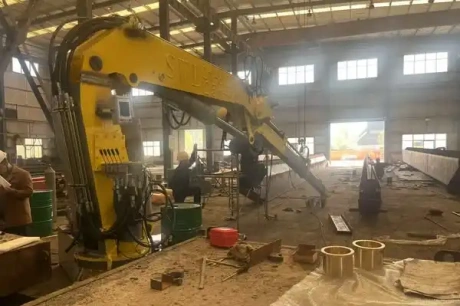
3.Certification affects the manufacturing process, not just the paperwork. A crane being built to DNV class requires classification society inspection at specific production milestones. Changing the requirement after manufacturing has started causes delays and additional cost.
Cold-Start Performance: A Requirement That Gets Specified Too Late
What Happens to Standard Hydraulic Systems Below -10°C
Hydraulic oil viscosity increases as temperature drops. Below -10°C, standard hydraulic oil in an unheated system becomes sluggish enough to cause slow pressure build-up, delayed valve response, and in some cases failure to start. This is not a theoretical risk for PSVs and SOVs working North Sea winter operations — it is a routine condition.
What a Properly Specified Cold-Start System Includes
1.Low-viscosity synthetic hydraulic fluid rated for sub-zero operation handles the fluid side of the problem. Thermostatically controlled heaters on the hydraulic tank and main valve blocks handle the pre-start condition — bringing the oil to normal operating temperature before the crane is called on to work.
2.Both provisions need to be in the specification before the crane is built, not retrofitted after a winter failure. A crane that won't cold-start reliably in January is out of service exactly when the vessel is most likely to need it.
Questions Worth Asking Before the Purchase Order Is Signed
What is the stowage envelope in parked position, with dimensions?
The headline working radius is not the number that affects daily operations. The stowage envelope — how much deck space the crane occupies when folded — is. Ask for a dimensional drawing showing the parked crane footprint and the clear space around it.
What classification society inspection occurs during manufacturing, and at which milestones?
Documentation provided at delivery is not the same as class inspection during production. If the contract or vessel approval requires class-surveyed manufacturing, confirm when and how the survey happens.
What hydraulic provisions are included for cold-start performance?
Ask specifically which hydraulic fluid is specified and whether tank and valve block heaters are included. A rated minimum temperature without the engineering behind it is not a credible answer.
What is the realistic lead time from order to delivery?
Standard configurations with DNV or BV certification typically run 14–18 weeks from order confirmation, plus shipping. Non-standard specifications or additional survey requirements extend this. If the crane delivery needs to align with a drydock window or vessel delivery date, confirm the lead time before the drydock is scheduled.
What on-site commissioning and AHC calibration is included in the scope?
A crane that arrives without commissioning support has a higher early-failure rate. For AHC systems, on-site sea trial calibration is not optional — it is the step that determines whether the AHC performs to specification under real conditions.
FAQ
What deck crane capacity is typical for an SOV working offshore wind maintenance?
Most routine lifting work on an SOV — spare parts, tooling, provisions, and equipment transfers to turbine access platforms — falls within a 5–15 tonne range. Vessels supporting heavier component replacement work may specify 20–30 tonnes. Check the full load chart against the actual working radius, not just the headline capacity: a crane rated at 10 tonnes at 5 metres may lift only 4 tonnes at the 15-metre radius where the real lifts happen.
What changed for deck crane certification from January 2026?
New SOLAS Regulation II-1/3-13 requirements came into force on 1 January 2026, requiring annual thorough examination and load testing every five years under an IMO scheme for onboard lifting appliances. Operators with existing vessels need to confirm their crane documentation is in the new DNV IMO scheme. New crane orders should specify the SOLAS requirement from the outset.
Can AHC be retrofitted to an existing deck crane?
Passive heave compensation can sometimes be retrofitted. Full active heave compensation typically requires a new crane — the winch, control system, and structural integration requirements of AHC are substantially different from a standard crane. If there is any realistic possibility of needing AHC, specify it in the original crane rather than planning a retrofit later.
How long does AHC calibration take on a working vessel?
Typically two to four weeks of sea trial time, depending on sea state availability and the range of load and motion conditions that need to be tested. The timeline cannot be compressed by testing in calm conditions — the calibration needs to happen in sea states representative of the operating environment.
If you're specifying a deck crane for a PSV or SOV operating in an offshore wind environment, send us the vessel type, operating area, and primary lift requirements. We'll confirm whether our marine crane range is a fit and provide the full load chart for your working radius.
HENAN YUNTIAN CRANE CO., LTD.
Email:sales@sgycranes.com
Website: [https://yuntiancrane.com/]
Whatsapp:+86-17337353108


