



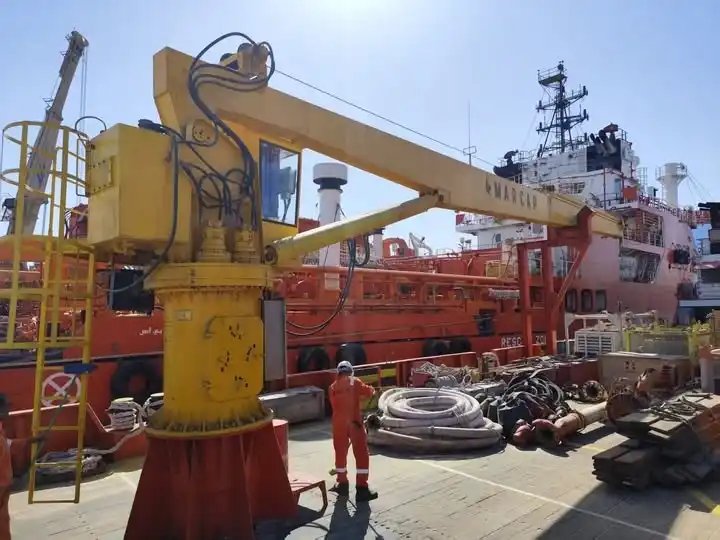
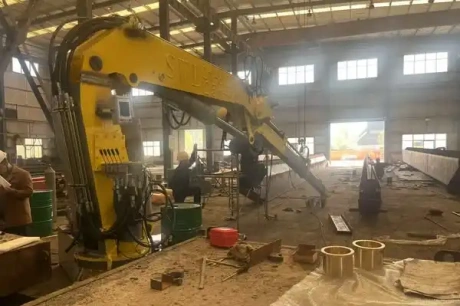
MARINE STIFF BOOM CRANE SEARCH INTEREST CLIMBS AS OFFSHORE WIND AND HEAVY CARGO PROJECTS EXPAND
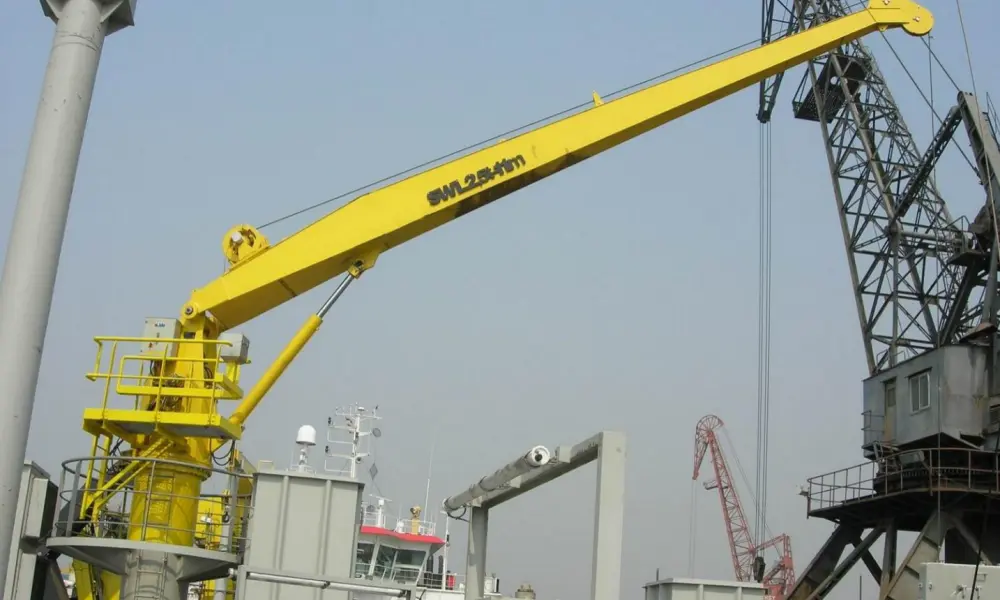
What‘s Driving the Search Growth for Marine Stiff Boom Cranes?
The search growth around marine stiff boom cranes tells a clear story, and it mirrors what‘s actually happening on the water.
Offshore wind is getting heavier.
Modern turbines are not the same machines we installed ten years ago. Nacelles weigh as much as a loaded shipping container, and blades now stretch longer than a football pitch. Installing and servicing these parts requires a crane that lifts heavy, does it the same way every time, and doesn’t fail mid-lift. Stiff boom cranes, with their rigid arm and winch-based lifting, are purpose-built for this kind of predictable, repeatable work.
Fewer moving parts, lower maintenance.
Ask any fleet manager in a saltwater environment, and they’ll tell you complexity is the enemy of uptime. Stiff boom cranes don’t have the folding joints or telescoping sections that give articulated booms their flexibility, and that’s exactly the point. Fewer seals, fewer pins, fewer places for corrosion to eat into the crane. Over a twenty-year service life, the difference in total maintenance spend is significant, and procurement teams are starting to factor that into their search behavior.
Oil and gas hasn‘t gone anywhere.
Deepwater exploration continues in the North Sea, the Gulf of Mexico, and the South China Sea. These installations rely on platform cranes that work every day with minimal downtime. Stiff boom cranes are the industry default for these permanent installations, and with a wave of platform refurbishment underway, replacement demand is quietly driving search volume.
Technology has caught up with the rigid arm.
Today’s marine stiff boom crane is not the same machine it was two decades ago. Active Heave Compensation now allows a rigid crane to transfer loads between a moving vessel and a fixed platform without the load swinging unpredictably. Remote diagnostics let fleet managers monitor performance from shore, reducing the need for offshore visits. These are the kinds of features that technical buyers actively search for.
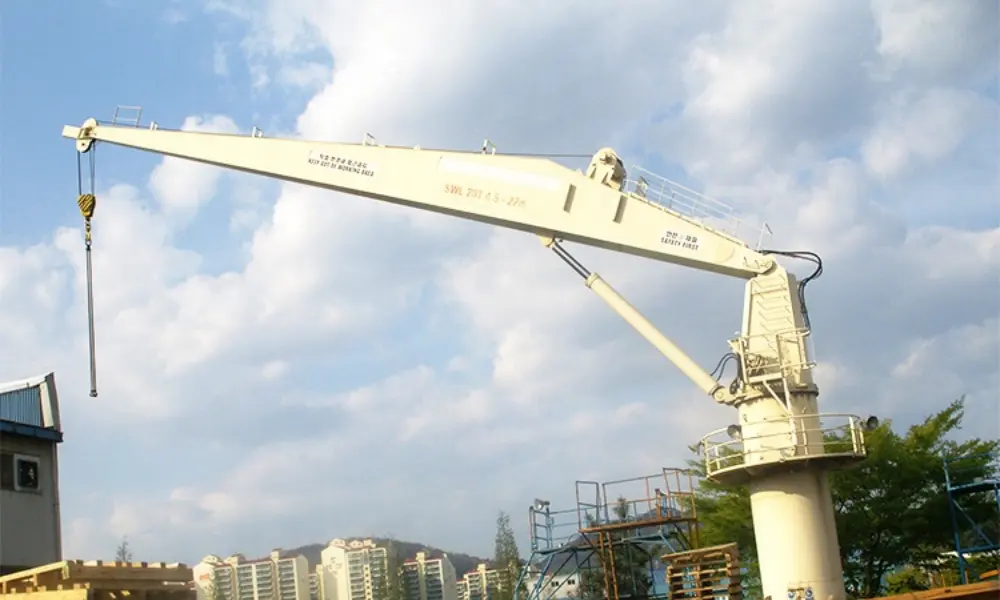
Why Offshore Wind Developers Are Choosing Stiff Boom Cranes
Offshore wind developers are choosing marine stiff boom cranes for a very simple reason: the turbines have grown too big for anything else.
The components keep getting heavier.
A next-generation nacelle can weigh north of 700 tons. A single blade can run past 110 meters. Try hoisting that kind of load off a moving deck in open water, and you quickly realize that a crane with a single rigid steel arm — no folding joints, no hinge pins, no extra hydraulic cylinders — is exactly what you need. Fewer pivot points means less deflection at full reach, and less deflection means the load goes where you aim it.
Stability matters more than maneuverability at sea.
When the wind picks up mid-lift, the last thing you want is a crane with multiple joints introducing extra sway. A stiff boom’s rigid structure gives the operator direct control, and when you pair that with Active Heave Compensation, the hoist line adjusts to wave motion automatically. The load stays steady, even when the vessel underneath is not.
Fewer breakdowns in places where breakdowns are expensive.
Downtime offshore is expensive in a way that’s hard to overstate. Marine Stiff boom cranes have fewer seals, fewer exposed hydraulic rods, and fewer flexible hoses than articulated alternatives — which means fewer places where saltwater can work its way in. For a project manager watching a weather window shrink, that reliability translates into fewer delays.
Cost matters, and so does simplicity.
The money side matters too. Stiff boom cranes are simpler to build than equivalent knuckle boom or telescopic models, so they cost less upfront. Routine maintenance is faster, repairs need fewer specialists, and parts are easier to find. In a business where every cent of the levelized cost of energy gets scrutinized, the total cost story is hard to ignore.
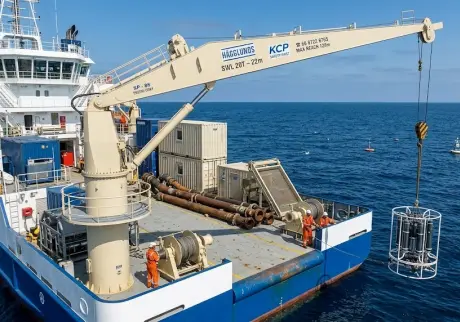
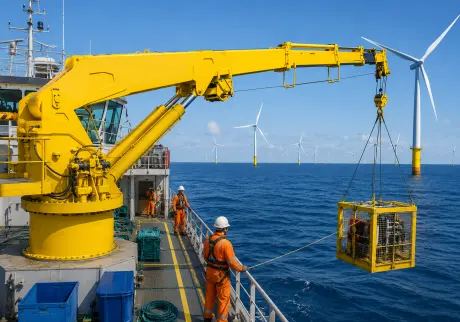
Marine Stiff Boom vs Marine Telescopic Boom Cranes: Which One Fits Your Vessel?
Picking between a stiff boom and a marine telescopic boom crane really comes down to how you use your vessel, how much deck room you’ve got, and how big your loads are. One is all about raw strength and simplicity, while the other leans hard into saving space and staying versatile.
Maintenance cost.
A marine stiff boom crane is basically a single rigid steel arm with very few moving parts. No internal telescoping cylinders, no nested wear pads, none of the hidden hydraulics that come with telescopic booms. Fewer parts in a saltwater environment means fewer things to corrode, leak, or break. In the long run, the maintenance schedule is predictable and relatively light. A marine telescopic boom, on the other hand, needs regular attention. The multi-stage extending sections rely on internal hoses, sliding wear pads, and seals that have to be inspected, lubricated, and eventually replaced. If those components get jammed or start leaking, the repair cost can ramp up quickly, and the crane is out of action while it’s being fixed.
Lifting capacity.
If raw lifting power at full outreach is your priority, the stiff boom wins. The solid, unbroken steel structure handles heavy dead-weight loads without the structural flexing that comes with multi-jointed designs. Telescopic booms are strong too, but the further you extend them, the more you have to de-rate the safe working load. At full stretch, the leverage on the boom joints and extension cylinders limits what the crane can safely lift.
Deck space.
This is where the telescopic boom pulls ahead. When fully retracted, it takes up very little room, which is a big deal on smaller vessels or crowded work decks. A stiff boom crane, by contrast, has a permanent footprint. The rigid arm can’t fold or shrink, so it sits across a long section of the deck even when it’s not working. On a vessel where every square metre counts, that fixed position can be a real headache.
Wind resistance.
In high winds, the stiff boom’s single thick profile behaves predictably. There’s no internal play or shifting within the boom itself, which helps keep the load steady during high-altitude lifts. Telescopic booms, especially when extended, catch crosswinds more easily. The extra surface area acts like a sail, and that sideways force can stress the internal boom guides and cause the load to sway.
Which one fits your vessel?
If you’re running a wind turbine installation vessel, a heavy-lift barge, or a large cargo ship where capacity and uptime matter most, go with a stiff boom. If you’ve got a smaller workboat, a research vessel, or any platform where deck space is tight and the crane needs to tuck away when it’s not in use, a telescopic boom is the better fit.
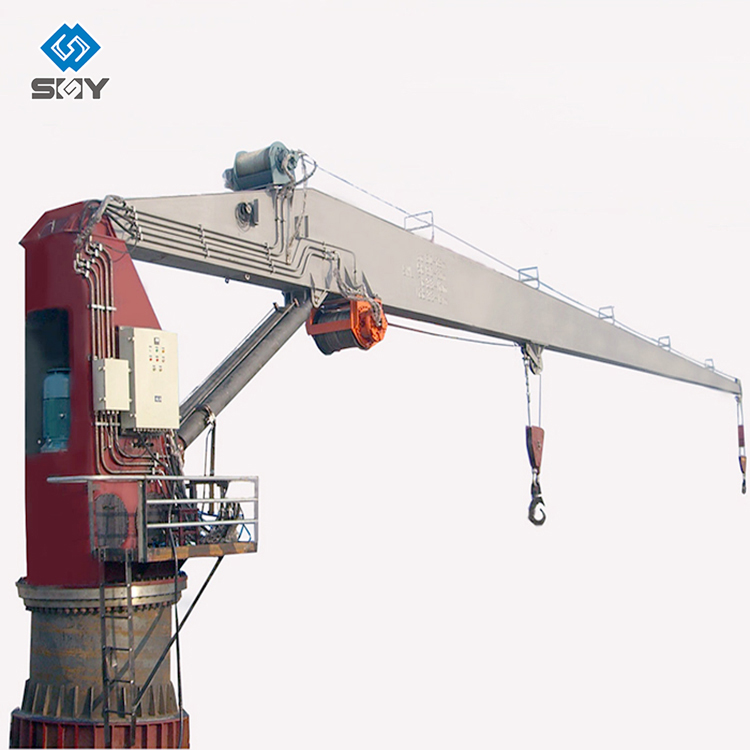
Lower Maintenance, Longer Life: The Operational Case for Marine Stiff Boom Cranes
When you spread the cost of a marine crane over its full service life, the numbers tell a story that spec sheets alone can't capture. Roughly two-thirds of a crane's total lifecycle cost happens after the first year, and that's where the stiff boom's simple design quietly pulls away from more complex alternatives.
The real savings start with the hydraulic system.
Articulated and telescopic cranes rely on multiple stages of cylinders, hoses, wear pads, and hinge points, and industry data across heavy equipment suggests that around 40% of mid-life failures trace back to hydraulics. A stiff boom crane eliminates the secondary knuckles and extending segments altogether, which means roughly 60% fewer seals, hoses, and valves that saltwater can eventually compromise. Fewer components exposed to the marine environment means fewer leaks and fewer unplanned repairs.
The cost difference per incident is stark.
Replacing a standard hydraulic filter or performing a routine inspection runs a few hundred dollars. A major repair on a failed articulation joint or a damaged telescoping cylinder can easily run into the thousands per incident, before you factor in the technician's travel time to wherever the vessel happens to be docked. Routine safety certifications are also faster with a stiff boom, since there are no hidden cylinders or complex extension mechanisms to strip down and test, cutting billable inspection hours roughly in half.
Then there's the cost of not working.
For an offshore supply vessel or a wind installation platform, a day of unplanned downtime can cost anywhere from a few tens of thousands to over a hundred thousand dollars in lost charter revenue. The stiff boom's continuous steel arm eliminates the joint fatigue and micro-cracking that can take an articulated crane offline without warning, which matters enormously when you're working against a weather window that won't wait.
Over the long term, the depreciation math tilts further in the stiff boom's favor.
Articulated cranes often need major structural overhauls or full replacement by year fifteen, while stiff boom units regularly reach twenty-five to thirty years of service with only wire rope and winch replacements. Spreading that initial capital outlay over a longer useful life cuts the annualized depreciation by roughly 40%, and that's the kind of number that holds up when the accountants come asking.
The Specification Decision That Pays Off Over Twenty Years
A marine stiff boom crane is not the right answer for every vessel. If deck space is tight and the loads are light, a telescopic or marine knuckle boom may serve better. But for heavy, repeatable lifts in offshore wind, oil and gas, or bulk cargo operations — where uptime matters and maintenance budgets get scrutinised — the marine stiff boom's case is straightforward: fewer parts, longer service life, lower total cost.
If you're working through a crane specification for a new vessel or a retrofit, our marine stiff boom crane range covers capacities from 3 to 300 tonnes, with AHC options and full classification society certification. You might also find it useful to compare configurations across our broader marine crane range before committing to a design type. Send us your vessel type and primary lift requirement — we'll confirm whether a stiff boom is the right fit and provide the load chart for your working radius.
HENAN YUNTIAN CRANE CO., LTD.
Email:sales@sgycranes.com
Website: [https://yuntiancrane.com/]
Whatsapp:+86-17337353108





