



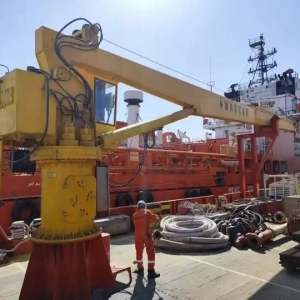
Marine Crane (Deck Crane)
Complete Guide: Selection, Application & Maintenance
Marine crane (also called deck crane or shipboard crane) is essential for cargo handling on vessels and offshore platforms. This guide covers knuckle boom, telescopic boom, straight boom and conventional cranes; key technical parameters (lifting capacity, radius, active heave compensation); marine-grade design (C5-M corrosion protection, IP56); classification society certifications (CCS/ABS/DNV/LR/BV); and full lifecycle maintenance. HENAN YUNTIAN offers customized marine cranes widely used on supply vessels, bulk carriers, and offshore wind platforms
1. What is a Marine Crane?
1.1 Definition & basic function
A marine crane (or deck crane) is a lifting device installed on ship decks, offshore platforms, or floating facilities. It must withstand unique marine challenges: salt spray corrosion, vessel heeling/trimming, dynamic loads, and high winds.
1.2 Main application areas
· General cargo / multipurpose vessels – handling breakbulk, containers, bulk goods
· Work vessels – anchor handling, subsea equipment deployment
· Offshore platforms – supply lifting, personnel transfer
· Naval ships – ammunition replenishment, boat handling
· Fishing vessels – net handling, catch loading
2. Main Types of Marine Cranes
2.1 By boom structure
Type |
Working principle |
Advantages |
Typical application |
Knuckle boom crane |
Articulated boom with hinge |
Compact stowage, flexible outreach |
Workboats, offshore supply vessels |
Telescopic boom crane |
Extendable boom sections |
Large radius variation, compact when idle |
Small freighters, fishing vessels |
Straight boom crane |
Fixed boom (no articulation) |
Simple, high capacity |
Bulk carriers, heavy lift vessels |
Conventional deck crane |
Slewing crane with lattice/hose |
Reliable, easy maintenance |
General cargo ships |
2.2 By drive type
· Electro-hydraulic – mainstream, smooth control, overload protection
· All-electric – fast response, no oil leak, ideal for eco-sensitive vessels
· Diesel-driven – for platforms or barges without external power
3. Marine Crane Core Technical Parameters
Parameter |
Typical range |
Selection consideration |
Lifting capacity |
1t – 200t |
Include weight of spreader/grabs if used |
Working radius |
3m – 40m |
Determines boom length coverage |
Lifting height |
above deck: 5-30m / below deck: to sea level |
Hold access or subsea lowering |
Slewing angle |
360° continuous or limited |
Full circle offers maximum flexibility |
Duty classification |
M3–M6 (ISO) / A1–A6 (FEM) |
Based on operating frequency |
3.2 Special condition parameters
· Heel/trim capability – safe operation at ±5° heel, ±2° trim
· Dynamic load factor – typically 1.1–1.3
· Wind speed survival – operational up to 20 m/s, survival >50 m/s
4. How to Select the Right Marine Crane for Your Vessel
4.1 Offshore supply vessel (OSV)
Recommendation: Knuckle boom, 3-10 t capacity, radius 15-25 m, optional AHC, ABS/DNV class.
4.2 Bulk carrier / multipurpose
Recommendation: Conventional or straight boom, 25-60 t, radius 20-30 m, can be equipped with grab, dual hoist winch.
4.3 Offshore wind installation platform
Recommendation: Heavy-duty knuckle boom (100 t+), active heave compensation, long outreach, remote control
5. Marine Environmental Adaptation
5.1 Anti-corrosion system
Component |
Standard |
Optional upgrade |
Steel structure |
Epoxy zinc + epoxy mica + polyurethane |
Thermal sprayed aluminum + sealer |
Hydraulic piping |
Stainless steel 316L |
Duplex stainless steel |
Electrical parts |
IP56 protection |
IP66 / NEMA 4X |
Fasteners |
Stainless steel / Dacromet |
Hastelloy |
5.2 Key safety systems
· Active Heave Compensation (AHC) – compensates vessel heave for stable load
· Anti-sway control – reduces load swinging
· Load limiter, anemometer, emergency release system
5.3 Classification society certification
CCS, ABS, DNV, LR, BV, NK etc. covering design, materials, manufacturing, and testing.
6. Operation & Maintenance Guidelines
6.1 Daily checks
· Wire rope (broken wires, corrosion), hook, limit switches, hydraulic oil level, emergency stop
6.2 Periodic maintenance schedule
Interval |
Maintenance task |
Remarks |
Weekly |
Structural bolt tightening |
Slewing bearing, boom pivot points |
Monthly |
Hydraulic oil cleanliness test |
Change return filter |
Quarterly |
Wire rope lubrication |
Marine-grade lubricant |
Every 6 months |
Slewing ring teeth inspection & greasing |
Check wear |
Yearly |
Safety valve calibration |
By accredited third party |
Every 5 years |
Full structural NDT |
Critical weld inspection |
6.3 Marine environment special care
· Rinse with fresh water after each voyage to remove salt
· If idle for long periods, operate slew/hoist weekly
· Check lowtemp hydraulic fluid before winter operations
· Ensure proper grounding to avoid lightning damage
7. Marine Crane Frequently Asked Questions (FAQ)
Q1: What is the difference between a marine crane and a land crane? Marine cranes feature C5-M corrosion protection, ship motion compensation, class society certification, compact design, IP56 rating, and dynamic load factors.
Q2: What is Active Heave Compensation (AHC) and when is it needed? AHC uses sensors to detect vessel heave and adjusts the hoist in real time to keep the load stable relative to sea bottom. Required for personnel transfer, subsea deployment, and rough sea lifting.
Q3: What is the typical service life of a marine crane? Design life is 2025 years with proper maintenance. Critical structures are often designed for infinite fatigue life.
Q4: What capacity margin should I consider? Normally +10%; for occasional max lift +20%; with AHC add +25% dynamic margin.
Q5: Which class society certificates are required? At least one flag state society (CCS, ABS, LR, DNV, BV, etc.). International vessels may need multiple. YUNTIAN provides any major classification.
8. Why Choose HENAN YUNTIAN Marine Cranes?
· Full classification approvals – CCS, ABS, DNV, BV, LR, etc.
· Marine-specific design – C5-M coating, IP56, 316L piping
· Active Heave Compensation – 95% heave reduction accuracy
· Modular & fast delivery – standard 46 months, class units 68 months
· Global service network – 430 outlets, spares worldwide
Project highlights: Supplied 30 knuckle boom cranes (8t, DNV certified) for 12 PSV vessels – zero major failures over 5 years. Four 50t heavy-duty marine cranes for West Africa offshore oilfield.
9. Information Needed for a Marine Crane Quotation
Category |
Details required |
Vessel type |
Newbuild / conversion? Ship type (bulker / OSV / platform, etc.) |
Lifting requirements |
Max capacity (t), working radius (m), lifting height (m) |
Operation profile |
Sea region, AHC needed, operating hours/day |
Space constraints |
Deck mounting position, stowage envelope, interferences |
Class society |
CCS / ABS / DNV / LR / BV / others |
Power supply |
Voltage (380V/440V/6.6kV), frequency 50/60Hz |
Special features |
Explosion-proof, low-temp, grab, remote control, automation |
Inquiry now: email sales@sgycranes.com or call +86-373-3055523.
Our offshore team will reply within 24h with a preliminary solution.





